
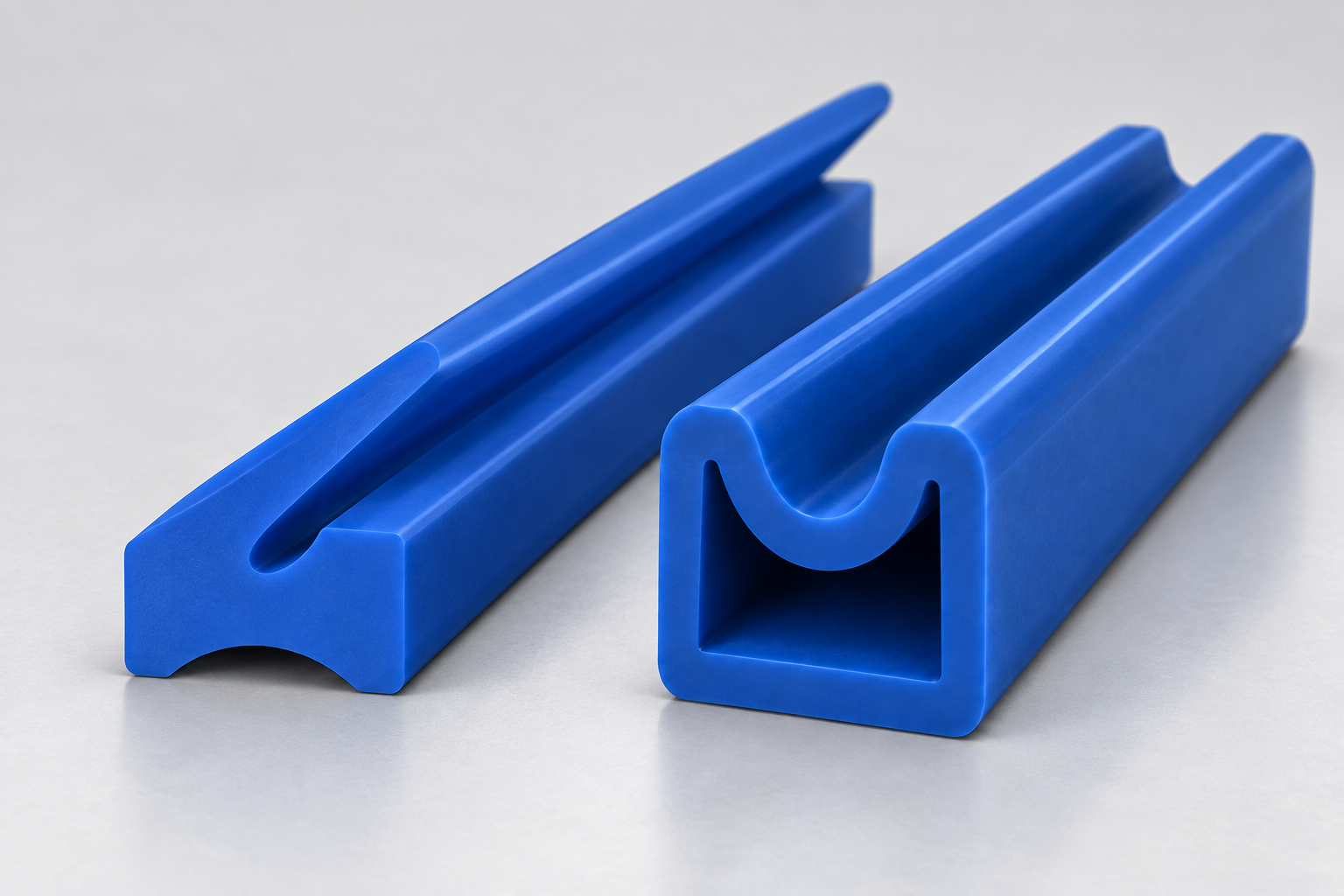
When selecting a seal, the first question is not just the cross-section shape: you also need to determine how contact with the opposing surface will be created. Standard and inflatable seals create this contact in different ways.
How does a standard seal work?
Here, standard seal refers to compression and lip profiles that are not inflated with air. When a lid or component closes, the seal is compressed or its flexible lip rests against the opposing surface. The lip seal in the image is one example; standard seals do not all have the same cross-section.
What changes with an inflatable seal?
When air is supplied to the hollow chamber in a controlled way, the profile expands in the intended direction to contact the opposing surface. Once the air is released, it retracts. Sealing contact can therefore be controlled as a separate step from the closing movement.
| Comparison | Standard seal | Inflatable seal |
|---|---|---|
| Contact | Mechanical compression or lip deflection | Expansion through controlled internal pressure |
| Connection | No inflation air required | A valve, air supply and exhaust are required |
| Selection | Assess compression and cross-section | Assess deflated cross-section, operating gap and movement direction together |
Which should you choose?
No single seal type is best for every application. Opening and closing frequency, gap, pressure differential, temperature and contact media must be assessed together. The final profile and operating pressure are determined using your application's technical data.
Compare seal profiles or share your application with our technical team.
Technical reference: Pawling — operating principles of inflatable seals. Product-specific values in this reference have not been used as specifications for the profiles on this page.