Inflatable Seals for Pharmaceutical & Medical Equipment
Controlled sealing at opening joints, from isolator doors to granulation and coating equipment. Explore seal locations, equipment examples and the information needed for a custom design.
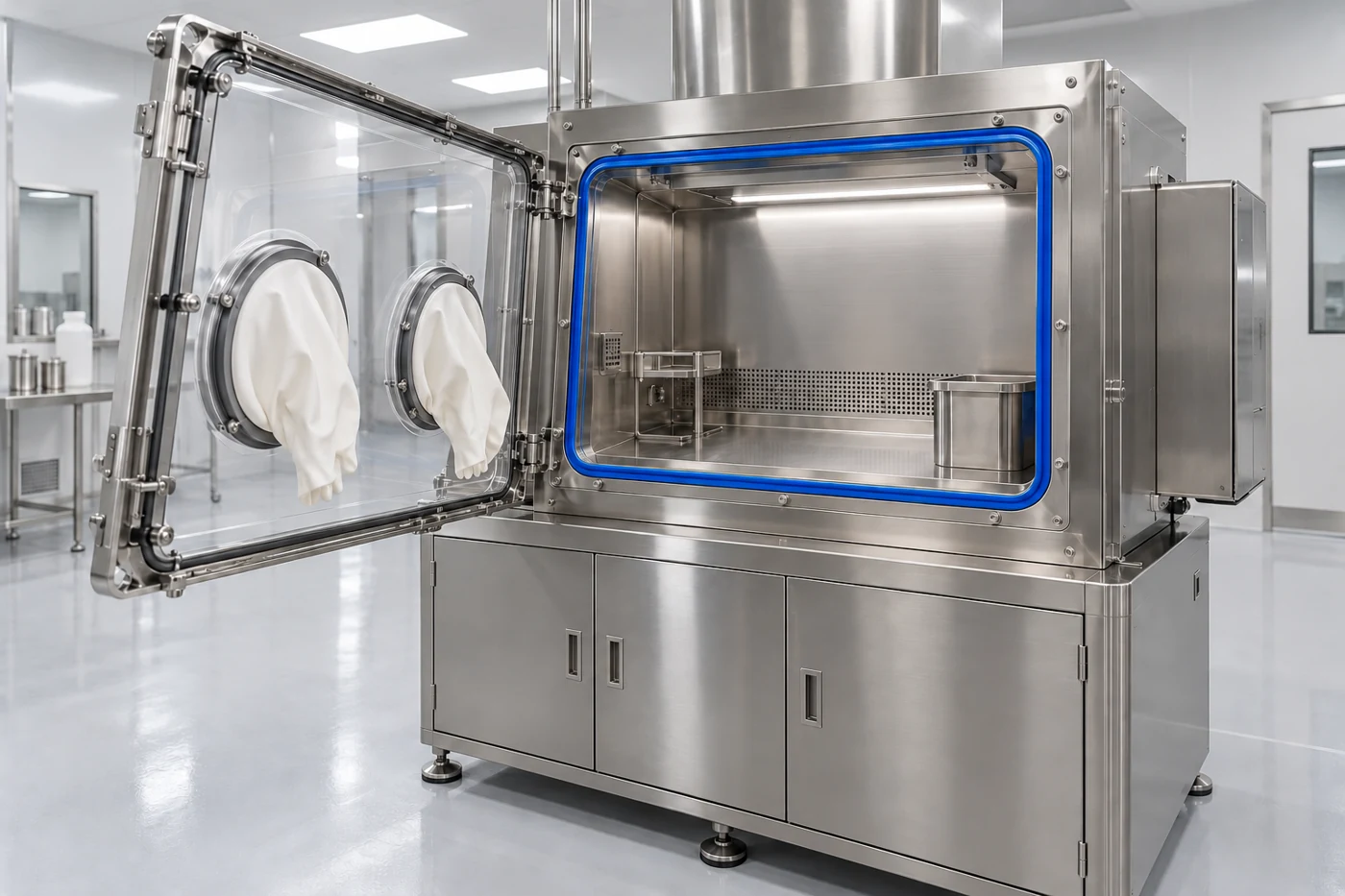
Perimeter channel between the front access panel and fixed opening
PHARMA & MEDICAL
Controlled sealing for hygienic processes.
Let us assess inflatable sealing solutions for doors, lids and process connections to suit your operating conditions.
Isolator doors
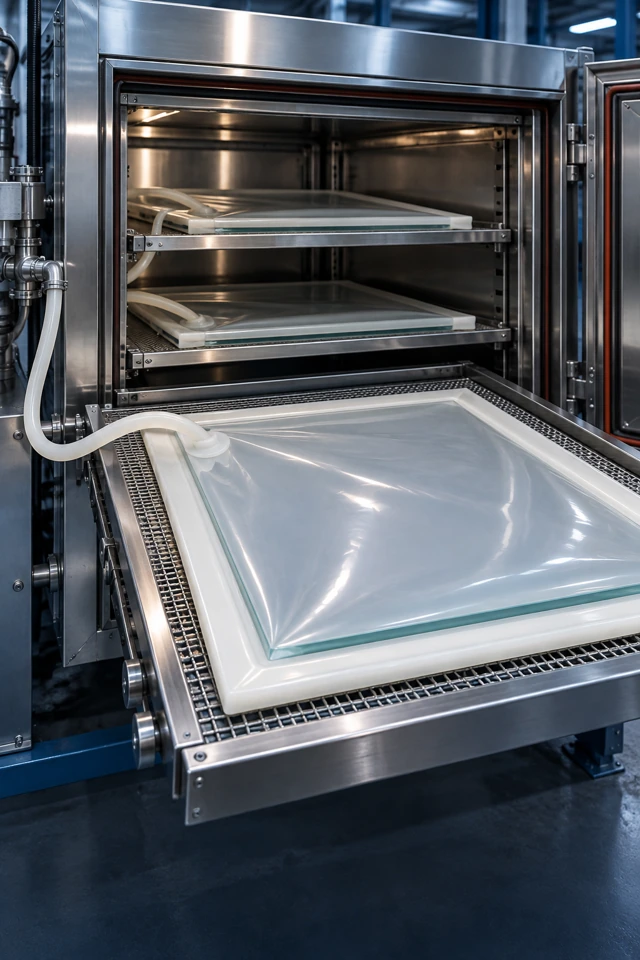
Sterilizer lids
Process equipment
Key factors in profile selection
Contact direction and operating gap
Groove dimensions and profile cross-section
Material and operating conditions
APPLICATION DETAILS
Equipment and sealing applications
Explore the equipment, the joint where the seal works and manufacturing options for your application.
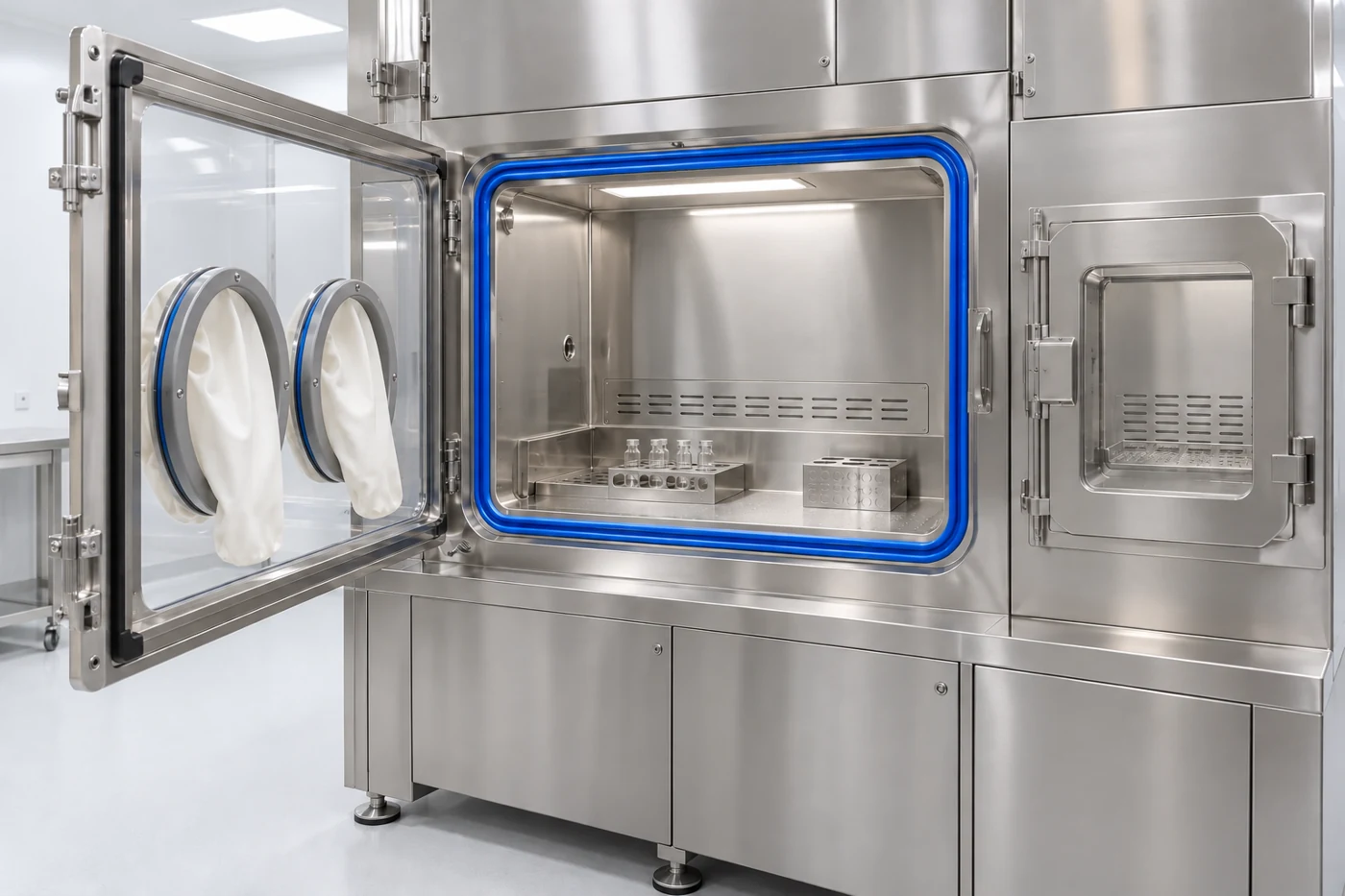
Enlarge image ↗Seal location: Perimeter channel between the front access panel and fixed opening
01 / EQUIPMENT AND PURPOSE
Glove-port isolator
Controlled sealing around a large access panel.
A glove-port isolator provides an enclosed volume for activities such as weighing, sampling or material preparation. Operators handle the product through gloves fitted to the panel.
An inflatable seal is retained in a suitable channel around the opening access panel or fixed aperture. The blue loop in the illustration surrounds the fixed aperture and establishes perimeter contact when the panel closes. The glove cuff and glove-port ring form a different joint.
Benefits of the seal
Enclose the working volume. Limiting leakage paths around the panel contributes to enclosure integrity.
Wide service access. Venting retracts the seal and allows the panel to open.
Contact after closure. Contact is established pneumatically.
Our manufacturing solution
We manufacture custom inflatable seals for this type of equipment. We assess the section, closed-loop dimensions, corner radii and air inlet arrangement against your drawing, and select the material for the temperature, product contact and cleaning conditions.
Selection and installation details
Include glass or transparent-panel deflection, locking points and closure tolerance in the sealing-gap assessment.
Select the profile for the product, cleaning liquid and any hydrogen peroxide decontamination cycle.
Design the channel for cleaning access and reduced product accumulation. Assess the splice and corners separately.
Define separate inspection and maintenance records for the main panel, transfer door and glove components.
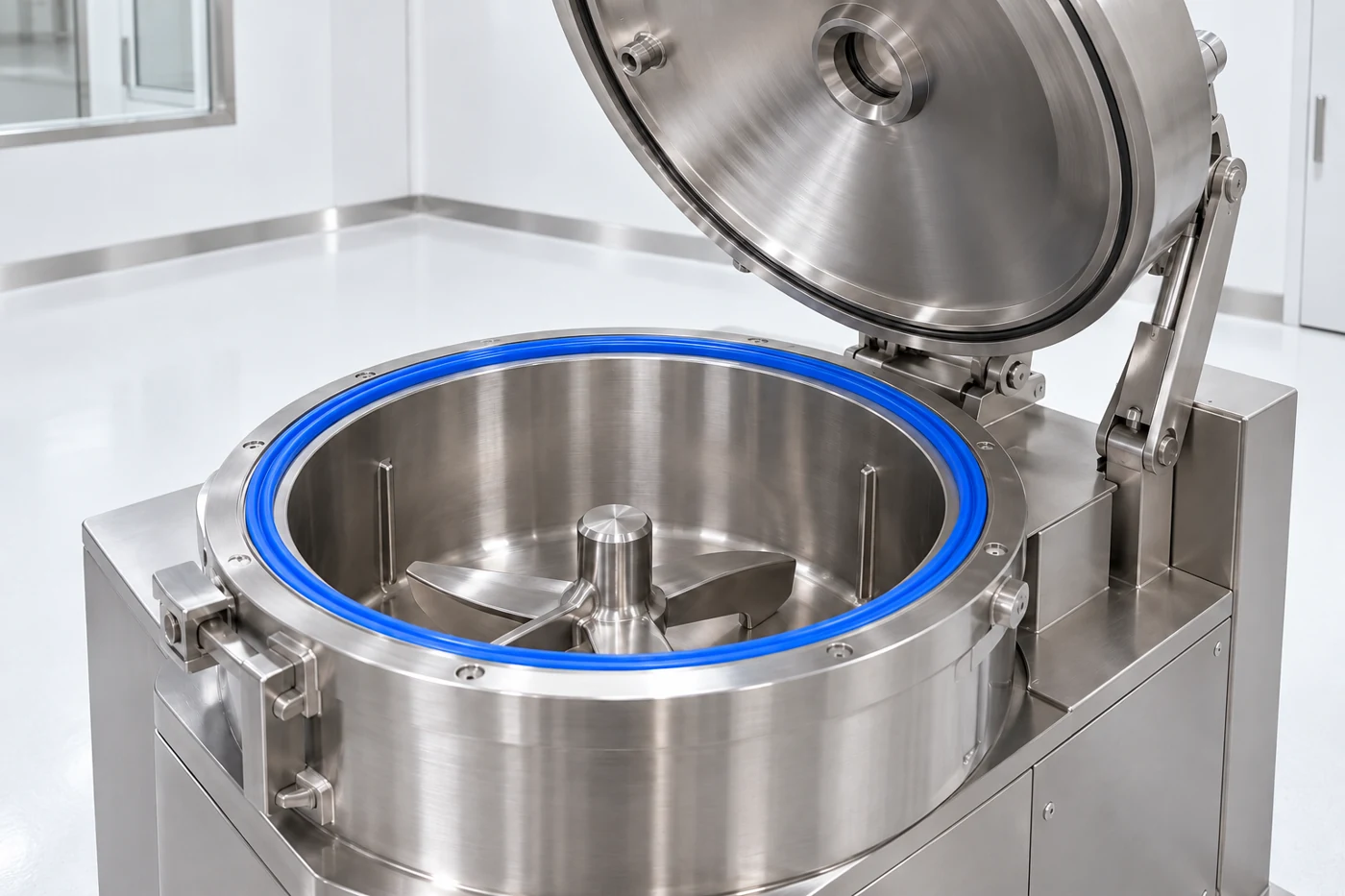
Enlarge image ↗Seal location: Perimeter joint between the vessel rim and lid
02 / EQUIPMENT AND PURPOSE
RMG high-shear granulator
Perimeter contact at the mixing-vessel lid.
An RMG mixes powders under high shear and supports wet granule formation when binder liquid is added. The main impeller moves the product bed; a chopper controls agglomerates as required by the process.
In a suitable equipment design, an inflatable seal is retained in a perimeter channel at the vessel mouth or in a lid retainer. The illustration shows the loop around the fixed vessel opening. After mechanical closure, the profile contacts the lid surface.
Benefits of the seal
Limit dust passage. The profile helps reduce the leakage path around the lid.
Maintain a closed process joint. Repeatable contact between lid and vessel supports closure under the defined operating conditions.
Access for cleaning and changeover. Releasing the air retracts the profile so the lid can open.
Our manufacturing solution
We manufacture custom inflatable seals for this type of equipment. We assess the section, closed-loop dimensions, corner radii and air inlet arrangement against your drawing, and select the material for the temperature, product contact and cleaning conditions.
Selection and installation details
Assess lid stiffness, locking force and vessel-mouth gap around the full perimeter.
Specify product powder, binder, solvents and WIP/CIP cleaning media together for material selection.
Protect the inflation connection from lid movement and product exposure without interrupting channel continuity.
Specify any process vacuum or pressure separately from inflation pressure. Equipment structural strength is a separate design requirement.
Enlarge image ↗Seal location: Ring between the removable product bowl and upper body
03 / EQUIPMENT AND PURPOSE
Fluid-bed dryer / processor
Controlled sealing at a removable bowl interface.
Conditioned air passes through a distributor and moves the powder or granule bed. An FBD is used for drying; suitable FBP arrangements can also perform granulation or coating with spray equipment.
An inflatable seal can be used at the perimeter joint where a removable product bowl meets the upper body. The illustration shows the blue loop on the underside of the upper section with the bowl separated. Depending on equipment design, filter or other body interfaces may have separate seals.
Benefits of the seal
Support the intended air path. Limiting unwanted leakage at the interface helps manage air through the designed inlet, product bed and outlet path.
Contain product dust. Closing the perimeter gap can contribute to reducing dust passage into the working area.
Bowl change and cleaning access. Within a suitable clearance, the deflated profile allows bowl separation.
Our manufacturing solution
We manufacture custom inflatable seals for this type of equipment. We assess the section, closed-loop dimensions, corner radii and air inlet arrangement against your drawing, and select the material for the temperature, product contact and cleaning conditions.
Selection and installation details
Assess bowl lifting, centring and the closed-position gap together. The seal is not a bowl support component.
Specify hot process air, product dust, solvents and cleaning cycles for the profile material and splice.
Make the channel and mating surface accessible for inspection and removal of dust deposits.
Assess body alignment and the bowl-lift lock to maintain the defined contact range around the full perimeter.
Enlarge image ↗Seal location: Perimeter between the drum access door and fixed housing
04 / EQUIPMENT AND PURPOSE
Tablet coating equipment
A perimeter barrier at the drum access door.
A tablet coater moves tablets in a rotating drum while spraying coating liquid. Conditioned process air supports liquid removal and formation of the coating layer.
In suitable coater configurations, inflatable seals are used around front viewing/access doors or side service doors. The illustration shows the blue loop around a fixed circular access opening, with the drum inside. The seal contacts the mating surface after the door closes.
Benefits of the seal
A barrier around the access door. The seal contributes to limiting passage of air, dust and aerosols at the joint.
Access between batches. Venting retracts the profile.
Repeatable perimeter contact. Once the door is positioned correctly, pneumatic expansion establishes a continuous contact line within the specified gap.
Our manufacturing solution
We manufacture custom inflatable seals for this type of equipment. We assess the section, closed-loop dimensions, corner radii and air inlet arrangement against your drawing, and select the material for the temperature, product contact and cleaning conditions.
Selection and installation details
Include aqueous or solvent-based coating liquids and cleaning agents in material assessment.
Check channel continuity and profile retention around circular or radiused openings.
Keep the seal clear of the drum, nozzles and door movement; allow access for residue removal.
Assess door deflection, locking points and temperature-dependent gap changes against the selected inflation range.
Enlarge image ↗Seal location: Sealing path between the door and pressure-vessel body
05 / EQUIPMENT AND PURPOSE
Medical steam sterilizer
Door contact suited to the temperature and pressure cycle.
A steam sterilizer processes suitable loads through a defined cycle. Air removal, saturated-steam exposure, pressure changes and drying are arranged for the equipment and load type.
In a suitable door arrangement, an inflatable seal sits in a channel around the chamber aperture and contacts the closed door surface. The illustration shows the door open to reveal the perimeter loop. Select the section for the inflation medium, temperature and door geometry of the specific equipment.
Benefits of the seal
Seal the chamber joint. The profile contributes to limiting leakage around the door.
Manage door movement. After suitable chamber conditions are established at cycle end, the profile can retract.
Planned inspection and replacement. An accessible channel and profile arrangement simplify perimeter inspection.
Our manufacturing solution
We manufacture custom inflatable seals for this type of equipment. We assess the section, closed-loop dimensions, corner radii and air inlet arrangement against your drawing, and select the material for the temperature, product contact and cleaning conditions.
Selection and installation details
Specify steam exposure, temperature, pressure/vacuum cycling and operating frequency together for material selection.
The inflation gas or medium follows the manufacturer design; this catalogue does not assign one common pressure setting.
Assess channel finish, drainage, corners and temperature-dependent gaps. Use lubricants only as allowed by the equipment instructions.
Manage door locking, pressure-chamber design and opening interlocks according to the equipment manufacturer design.
Enlarge image ↗Seal location: Access-panel perimeter of the protected working chamber
06 / EQUIPMENT AND PURPOSE
Radiopharmaceutical isolator
A perimeter barrier around access openings in a protected volume.
A radiopharmaceutical isolator organizes preparation, vial or syringe filling and dose operations within a controlled working volume. Its protective approach combines shielding, air management, filters, transfer compartments and remote or glove-port handling.
Inflatable seals may surround the main access aperture and suitable transfer-chamber doors. The blue loop in the illustration follows the fixed main aperture. Contact is established after the opening is closed and mechanically retained.
Benefits of the seal
Support the controlled volume. Limiting leakage around openings helps maintain the defined air and pressure regime.
Manage transfers. Door position and seal-pressure monitoring can be included in compartment transfer sequences.
Service access. Once the seal is vented, the relevant access panel can open.
Our manufacturing solution
We manufacture custom inflatable seals for this type of equipment. We assess the section, closed-loop dimensions, corner radii and air inlet arrangement against your drawing, and select the material for the temperature, product contact and cleaning conditions.
Selection and installation details
Specify process media, cleaning/decontamination chemicals and possible radiation exposure separately for material assessment.
Assess shielded-panel weight and hinge behaviour with the closed-position gap and locking arrangement.
Control main-volume and transfer-compartment seals separately for their pressure regime and opening sequence.
Locate connections and hoses in protected, service-accessible positions, clear of closing surfaces.
Images are representative application designs, not photographs of customer installations. The final profile, material and operating values are established during project review.
PREPARING YOUR PROJECT
What information is needed for selection?
Technical drawings and photographs of the existing installation help us assess the profile and connection options together. Include the following information with your enquiry.
Application-specific selection information
Information to provide
Assessment details
Equipment and joint
Door, lid or removable bowl drawing, including direct or indirect product contact.
Cleaning and process
Cleaning agents, concentration, exposure time and actual temperature at the seal.
Geometry and air supply
Groove section, closed gap, perimeter, corner radii and valve location.
Documentation
Define material documentation, traceability and acceptance test requirements when requesting a quotation.
Frequently asked questions
Can a seal in existing equipment be replaced?
We assess photographs, groove drawings and operating conditions. Matching overall dimensions alone is insufficient: the section, expansion direction and connection arrangement must also be checked.
Is one material suitable for every medical application?
Material selection depends on product contact, cleaning chemistry and temperature cycles. Required documentation and test criteria are verified for the specified compound and application.
How is inflation pressure specified?
Pressure is established together with the profile and closed operating gap. The equipment manufacturer's operating sequence and controls form part of the assessment.
Catalogue & technical resources
Explore the related catalogue and review profile and installation options alongside your application drawing.

 Enlarge image ↗