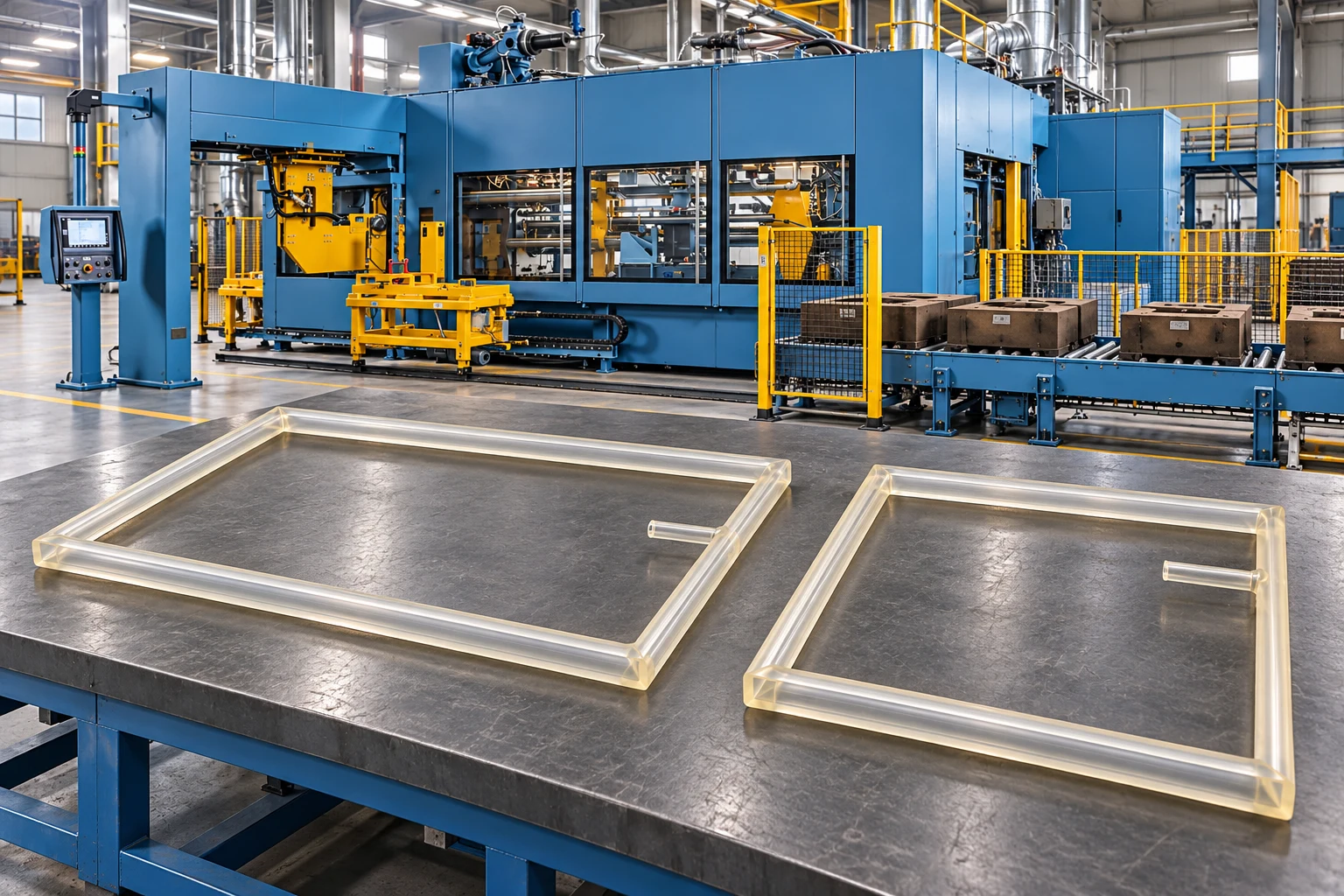
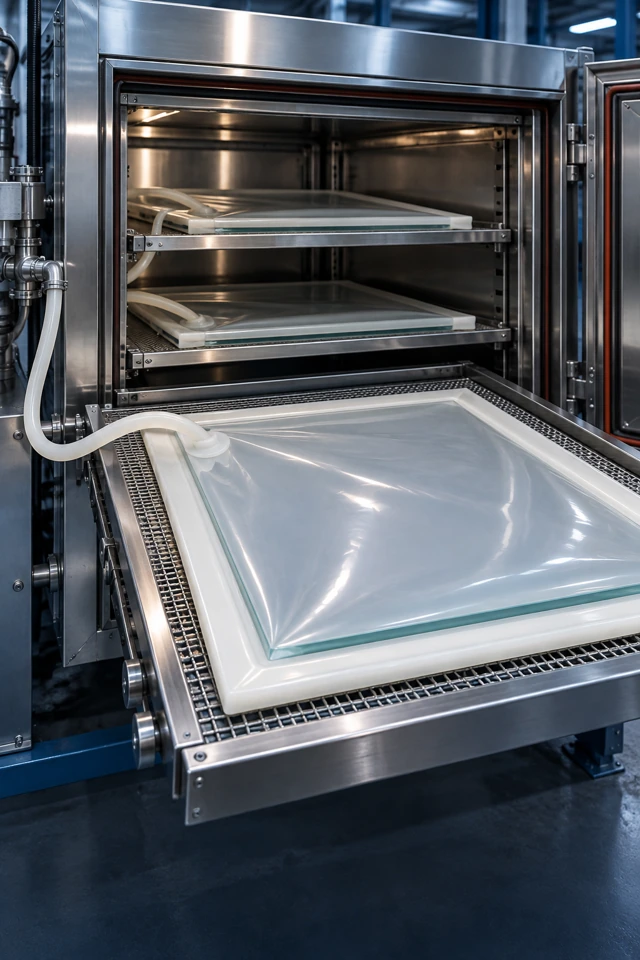
Explore door perimeter sealing for cleanrooms, airlocks and VHP transfer chambers. Door movement, pressure differential, cleaning procedures and groove geometry are assessed together.
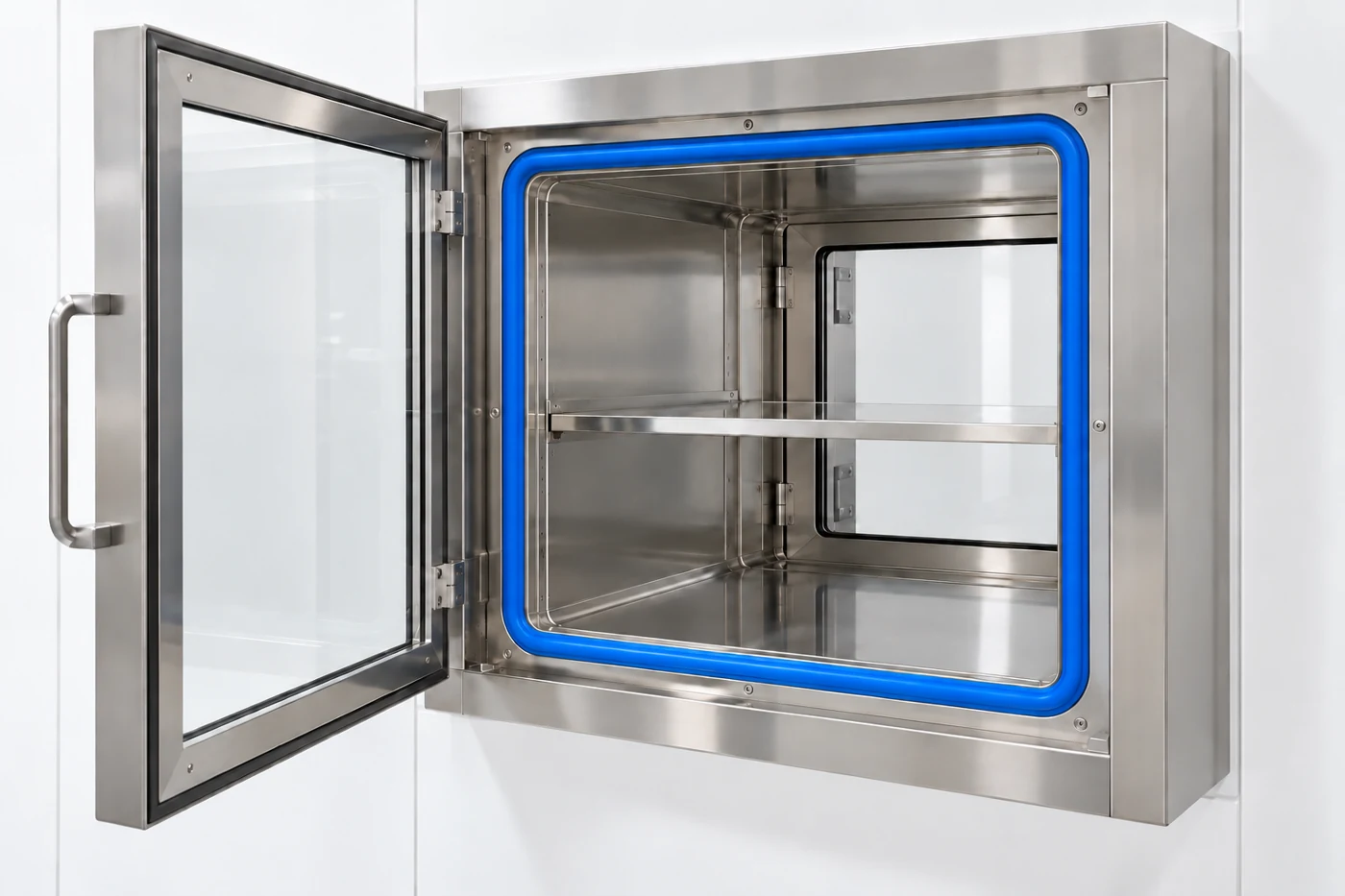
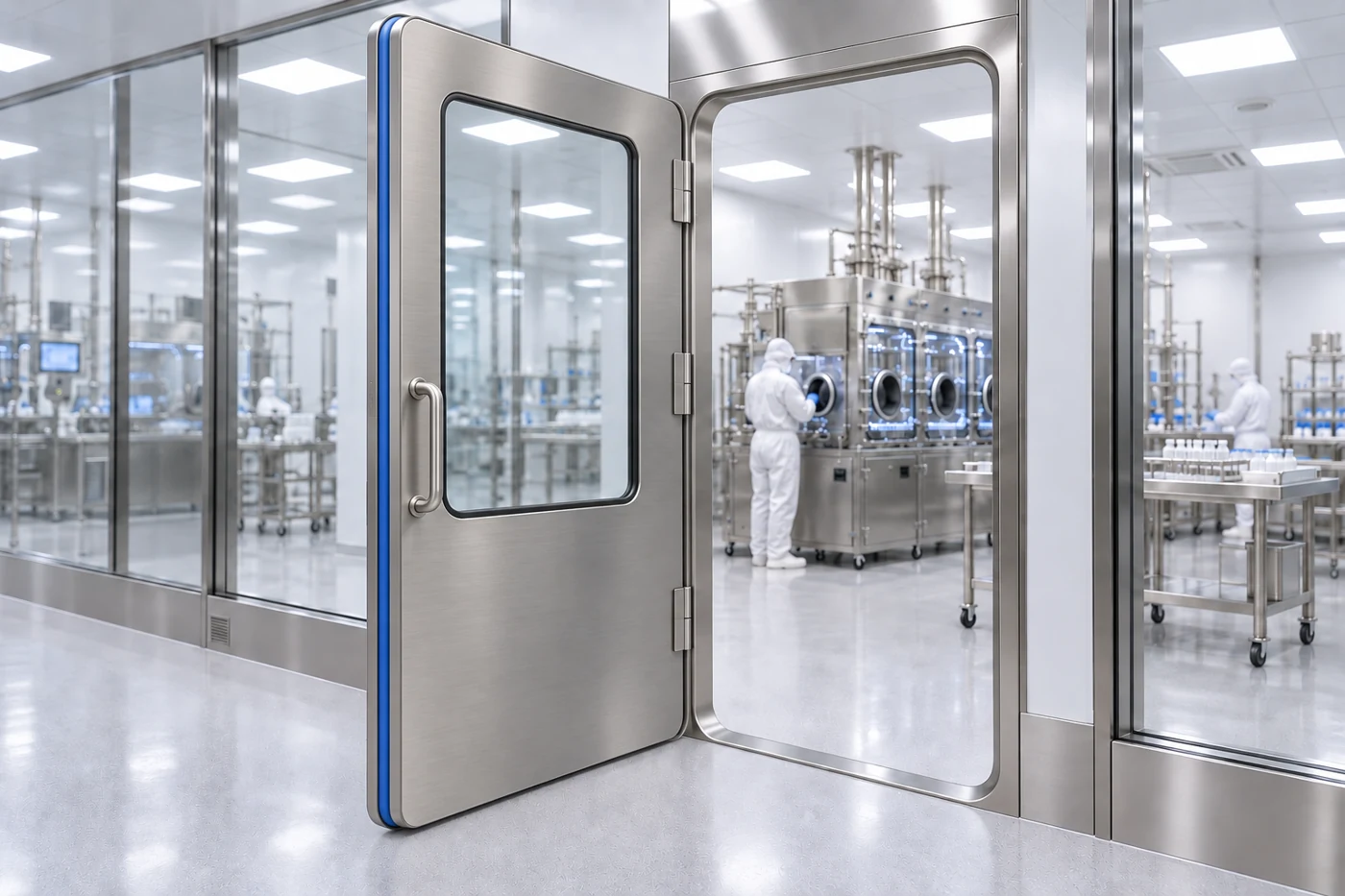
The blue seal in the illustration follows the narrow thickness edge of the stainless steel door leaf and is centred on that surface. When the door closes, it expands towards a suitable frame surface. Frame-mounted channel arrangements are also possible.
Benefits of the seal
A controlled perimeter barrier. The seal helps limit unwanted air passage through the leaf-to-frame gap.
Easier opening and closing. Within a suitable gap, the deflated profile retracts clear of the movement path.
Orderly, accessible mounting. Planning the channel and inflation connection protects the profile and provides access for inspection and replacement.
Our manufacturing solution
We manufacture custom inflatable seals for this type of equipment. We assess the section, closed-loop dimensions, corner radii and air inlet arrangement against your drawing, and select the material for the temperature, product contact and cleaning conditions.
Selection and installation details
Measure leaf thickness, closed-position gap and mating surface at the top, bottom and both sides. Centre the seal on the contact line defined in the drawing.
Match the corner radii of the leaf and frame. Avoid profile kinking or restriction of the internal air path at corners.
Protect the inflation connection and hose outside the hinge movement and closing contact surfaces.
Specify cleaning agents, access frequency and any decontamination conditions together for material selection.
Enlarge image ↗Seal location: Leaf-to-frame joint around the inlet and outlet doors
02 / EQUIPMENT AND PURPOSE
VHP transfer chamber
A perimeter barrier suited to the decontamination cycle.
A VHP transfer chamber moves materials between areas with different cleanliness requirements. After loading and door closure, a defined surface decontamination cycle is performed.
Inflatable seals are used around the inlet and outlet doors. The illustration shows a blue loop at the front fixed aperture and a second door opposite. Once the door is locked, the seal closes the contact line between leaf and frame.
Benefits of the seal
Support the cycle environment. Limiting leakage at door joints helps manage decontamination vapour within the intended volume.
Separate adjoining areas. Controlling perimeter contact and the opening sequence of both doors supports the management of direct passage between areas during transfer.
Access for repeated transfers. The profile retracts before opening.
Our manufacturing solution
We manufacture custom inflatable seals for this type of equipment. We assess the section, closed-loop dimensions, corner radii and air inlet arrangement against your drawing, and select the material for the temperature, product contact and cleaning conditions.
Selection and installation details
Specify peroxide concentration, exposure duration, temperature and possible condensation for material assessment.
Plan separately monitored air lines, lock information and seal pressure status for each door.
Assess radiused corners, the splice and inflation connection against the gas-tightness target.
Keep the seal path clear of shelves, handles and transfer movement, while preserving cleanable surfaces.
Images are representative application designs, not photographs of customer installations. The final profile, material and operating values are established during project review.
PREPARING YOUR PROJECT
What information is needed for selection?
Technical drawings and photographs of the existing installation help us assess the profile and connection options together. Include the following information with your enquiry.
Application-specific selection information
Information to provide
Assessment details
Door geometry
Leaf and frame dimensions, hinged or sliding movement and the closed gap around the perimeter.
Conditions between areas
Direction of pressure differential, leakage acceptance criteria and opening frequency.
Cleaning cycle
Cleaning and decontamination agents, exposure time and temperature.
Control system
Door position, locking, inflation and exhaust sequence, plus maintenance access.
Frequently asked questions
Does an inflatable seal determine the cleanroom classification?
Cleanroom performance is assessed together with air management, door arrangements, surfaces and operating procedures. The seal is one part of the door joint's sealing system.
What information is needed for VHP applications?
Provide the agent, concentration, cycle duration, temperature and repetition frequency. Material selection is assessed against these exposure conditions.
Can it be used on a sliding door?
It can be considered where the groove and operating gap are suitable. The seal must retract and provide clearance around the perimeter before the door moves.
Catalogue & technical resources
Explore the related catalogue and review profile and installation options alongside your application drawing.

 Enlarge image ↗