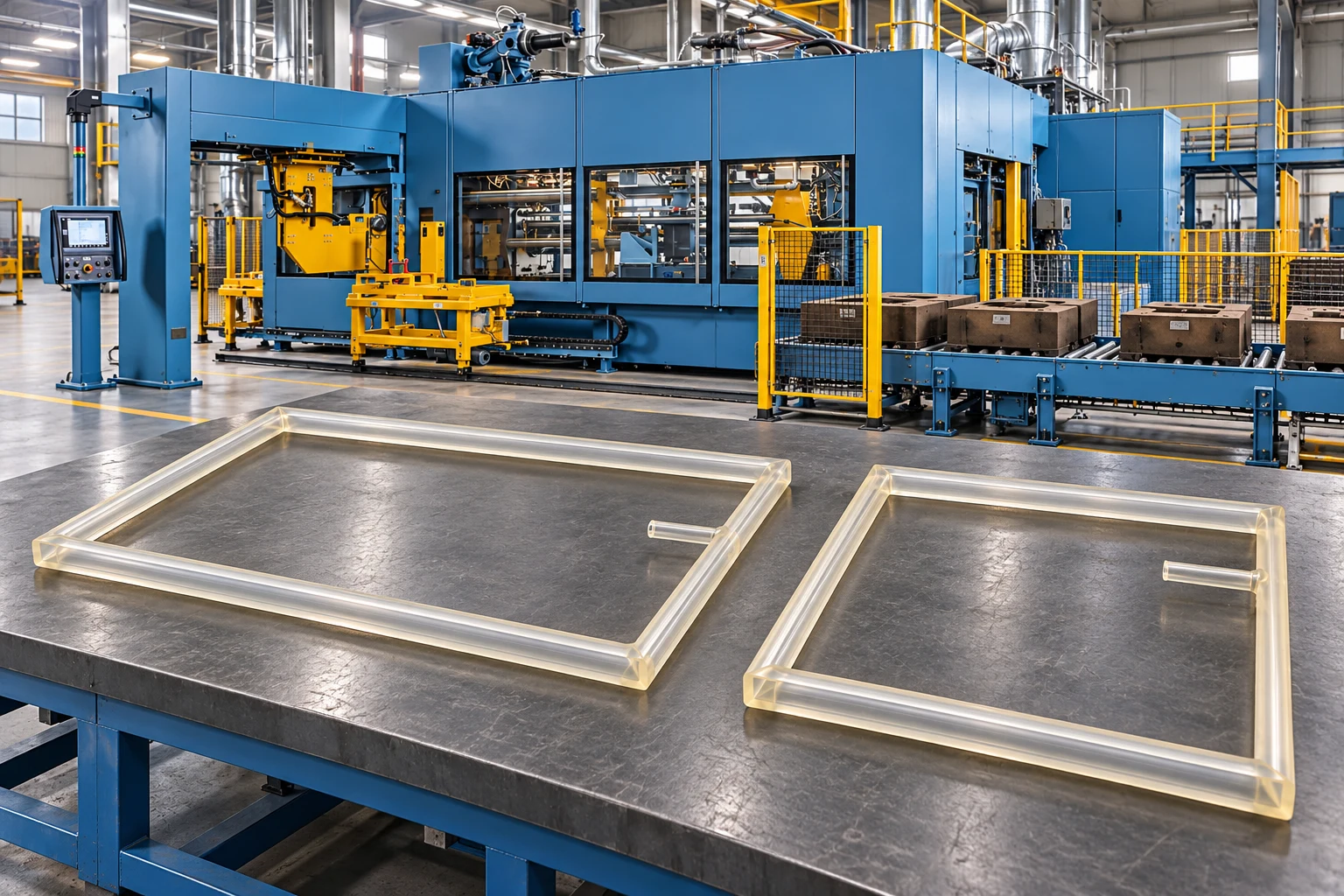
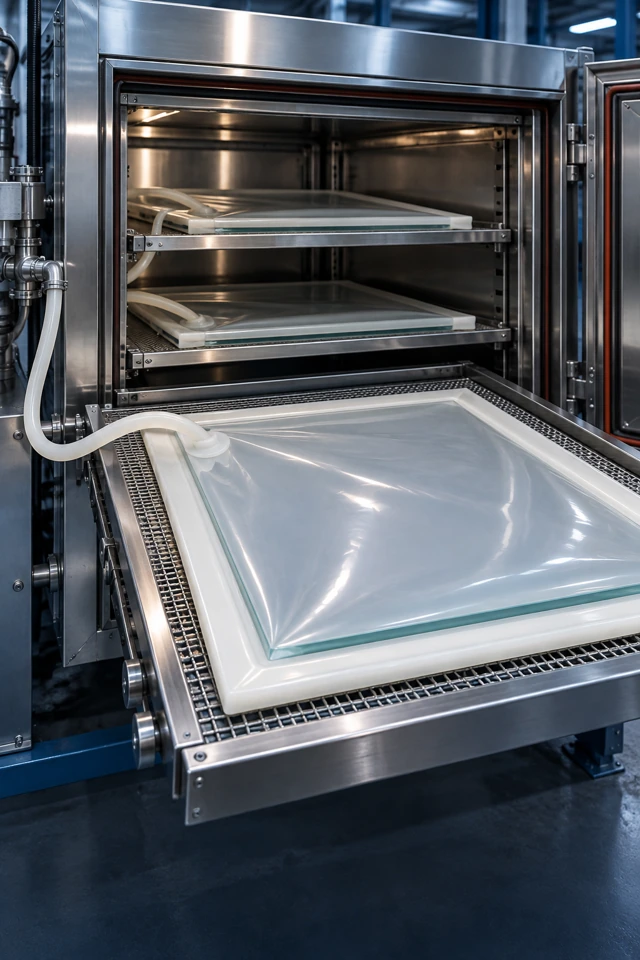
Perimeter sealing for saloon doors, side-deck entrances, beach clubs and tender garage hatches. Hatch geometry, surface tolerances and the marine environment are assessed together for a custom design.
Channel around the fixed opening and the mating surface of the closed leaf
MARINE
Door and hatch sealing for marine conditions.
Let us assess inflatable seals that conform to the mounting surface on yacht doors, garage hatches and service openings.
Yacht garage hatches
Service doors
Deck hatches
Key factors in profile selection
Hatch geometry and surface tolerances
Water exposure and operating environment
Retaining groove and corner radius
APPLICATION DETAILS
Equipment and sealing applications
Explore the equipment, the joint where the seal works and manufacturing options for your application.
Enlarge image ↗Seal location: Channel around the fixed opening and the mating surface of the closed leaf
01 / EQUIPMENT AND PURPOSE
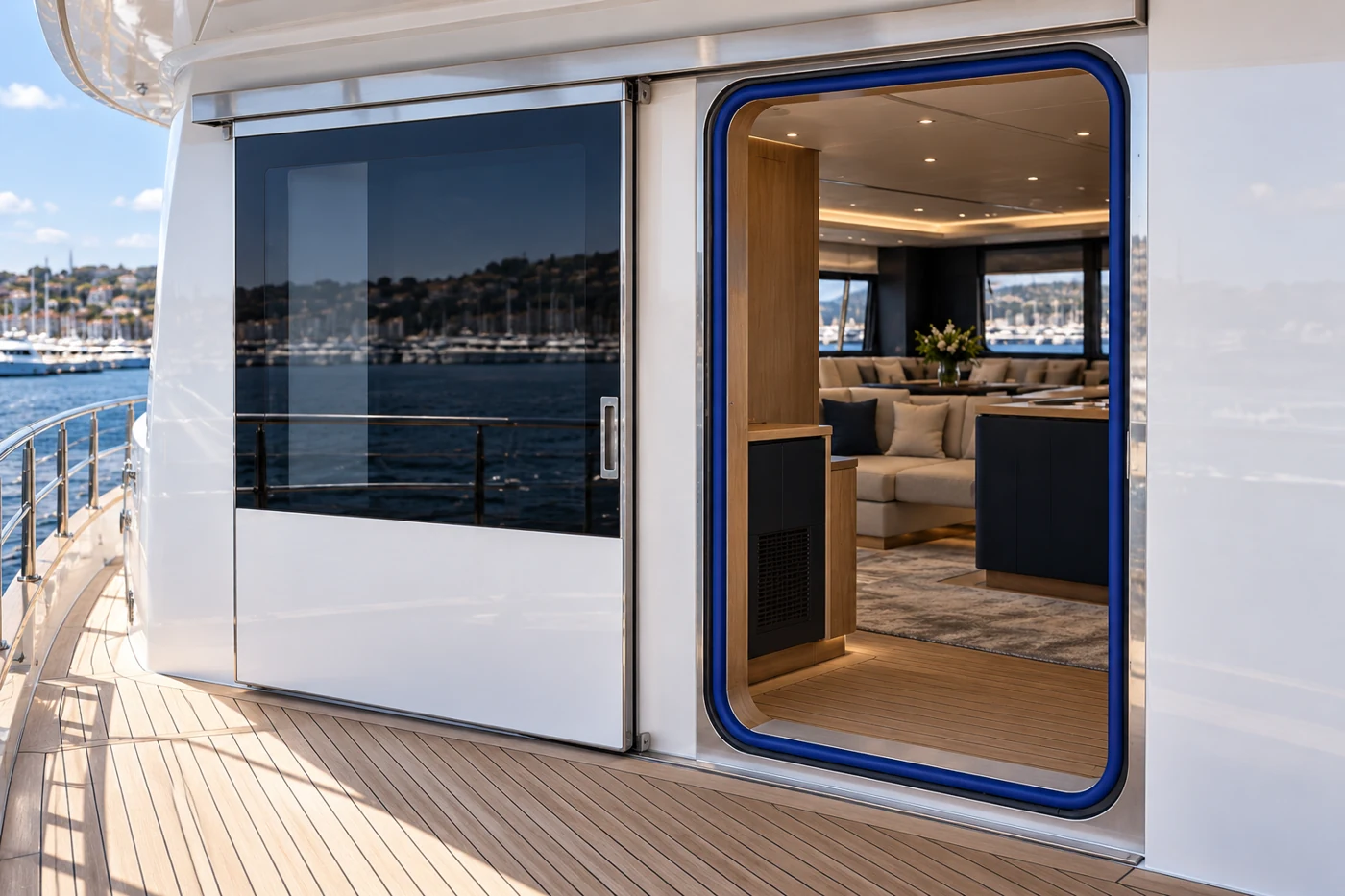
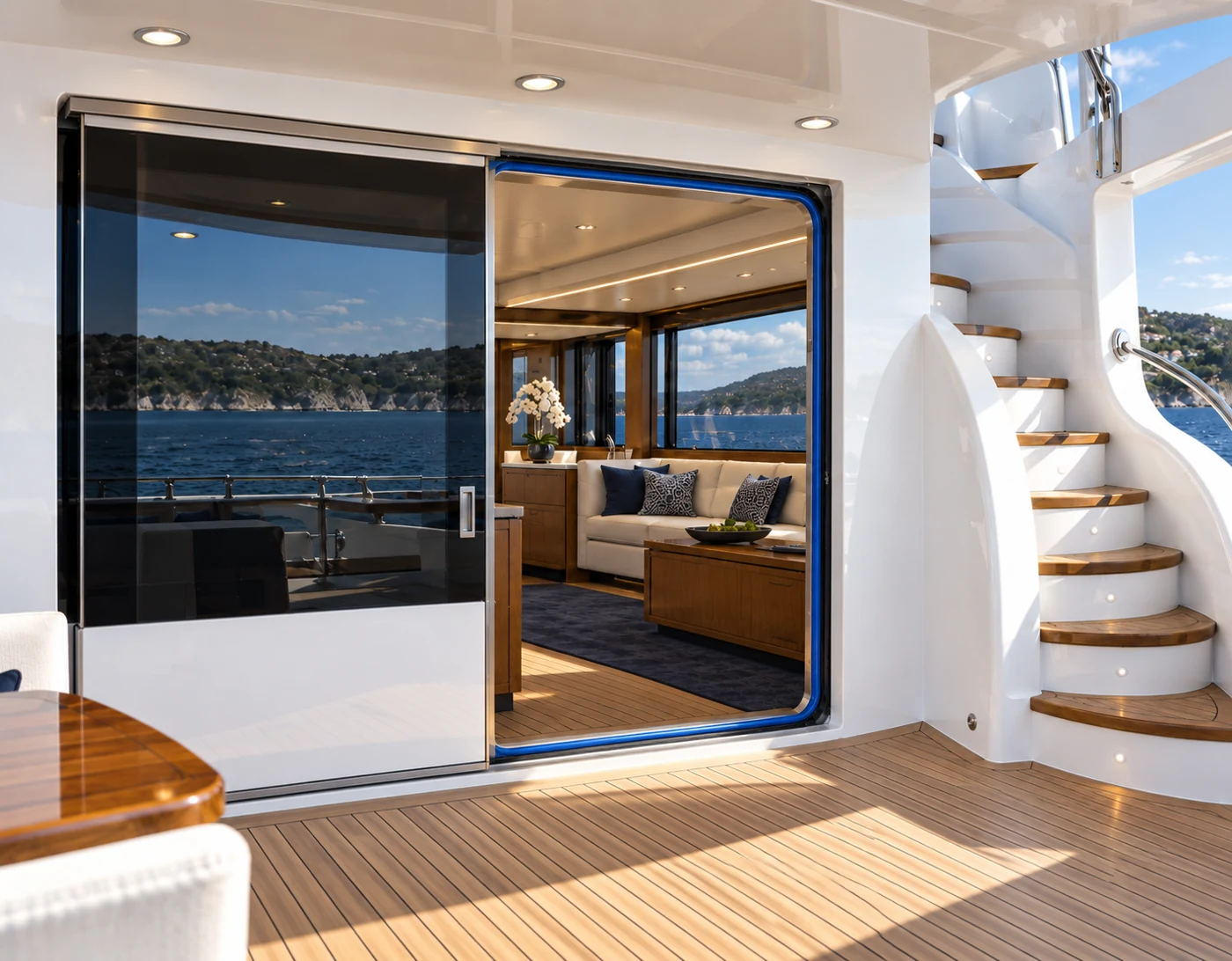
Sliding saloon doors
Protect interior comfort at the transition to the open deck.
Used on glazed sliding doors between the aft cockpit or seating deck and the saloon. The opening allows frequent access while the yacht is at anchor; when closed, the door forms the boundary between the interior and the outside environment.
The seal is installed in a suitable channel around the fixed frame. Once the door leaf reaches its final position and is mechanically secured, the profile inflates against the mating surface. Before opening, the air is vented so the leaf can move along its track.
Benefits of the seal
Interior protection. Helps limit rainwater and deck wash water passing through the perimeter joint.
Greater comfort. Reducing perimeter air leakage can help reduce draughts and wind noise caused by leakage paths.
Smooth movement. Retraction of the deflated profile reduces rubber contact during sliding.
Our manufacturing solution
We manufacture custom inflatable seals for this type of equipment. We assess the section, closed-loop dimensions, corner radii and air inlet arrangement against your drawing, and select the material for the temperature, product contact and cleaning conditions.
Selection and installation details
Track alignment, sill drainage and lock position are checked together. The seal must remain clear of the moving track components. Clean drainage channels and sills are an essential part of the complete installation.
Confirm that the seal has released around the full perimeter before sliding the door.
Enlarge image ↗Seal location: Channel around the fixed opening and the mating surface of the closed leaf
02 / EQUIPMENT AND PURPOSE
Side-deck access doors
Controlled sealing for sliding access along a narrow side deck.
Suitable for doors connecting a yacht's side deck to the saloon, a service passage or an enclosed living space. In a narrow walkway, a sliding leaf avoids the need for a large outward swing area.
The perimeter seal sits inside the fixed frame. Horizontal door travel and seal inflation take place at different stages. The deflated profile provides clearance; air is supplied only when the door is fully closed and locked to establish perimeter contact.
Benefits of the seal
Protection from exposure. Helps restrict rain and spray entering through the side-deck door joint.
Compact installation. A profile retained within a channel provides an orderly arrangement around the frame.
Service access. Accessible air inlets and retainers simplify inspection and seal replacement.
Our manufacturing solution
We manufacture custom inflatable seals for this type of equipment. We assess the section, closed-loop dimensions, corner radii and air inlet arrangement against your drawing, and select the material for the temperature, product contact and cleaning conditions.
Selection and installation details
Measure the working gap at the top, bottom and both sides. Track deflection, door sag or incorrect lock adjustment should be corrected mechanically rather than compensated for by increasing seal inflation.
Protect air tubing and connections from foot traffic and moving track components.
Enlarge image ↗Seal location: Channel around the fixed opening and the mating surface of the closed leaf
03 / EQUIPMENT AND PURPOSE
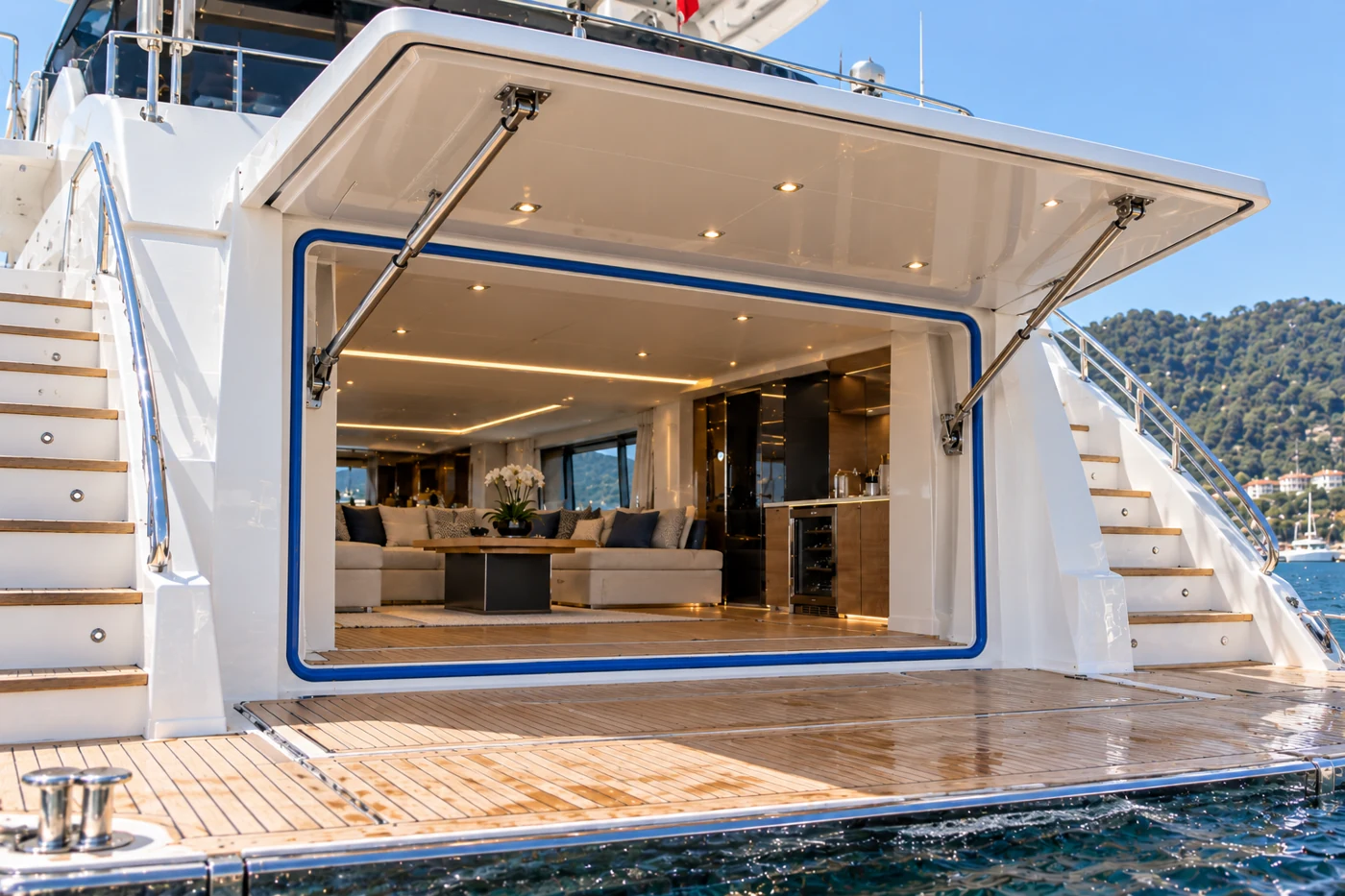
Aft beach club hatches
Perimeter contact for a large living space when the hatch is closed.
Used on large upward-opening hatches that connect an aft beach club, lounge or relaxation area to the outside deck. With the hatch open, the spaces merge; once closed, the perimeter joint needs to be sealed.
A closed-loop seal follows the fixed opening. It inflates after the hatch seats correctly and the locks engage. Within its specified working gap, the profile contacts the mating surface.
Benefits of the seal
Continuity around a large opening. Connects straight sections and radiused corners in a continuous sealing path.
Protection of interior fittings. With appropriate design and validation, helps limit water ingress and protect furniture and equipment.
Controlled contact. Can accommodate variations in the perimeter gap within the selected profile's working range.
Our manufacturing solution
We manufacture custom inflatable seals for this type of equipment. We assess the section, closed-loop dimensions, corner radii and air inlet arrangement against your drawing, and select the material for the temperature, product contact and cleaning conditions.
Selection and installation details
Hatch stiffness, locking points and corner geometry are considered together. Internal support-arm attachments and the space required when closed must stay clear of the seal path. The hatch should seat evenly against the sealing surface.
For an opening close to the water, define operating exposure and closed-hatch sealing tests at the start of the project.
Enlarge image ↗Seal location: Channel around the fixed opening and the mating surface of the closed leaf
04 / EQUIPMENT AND PURPOSE
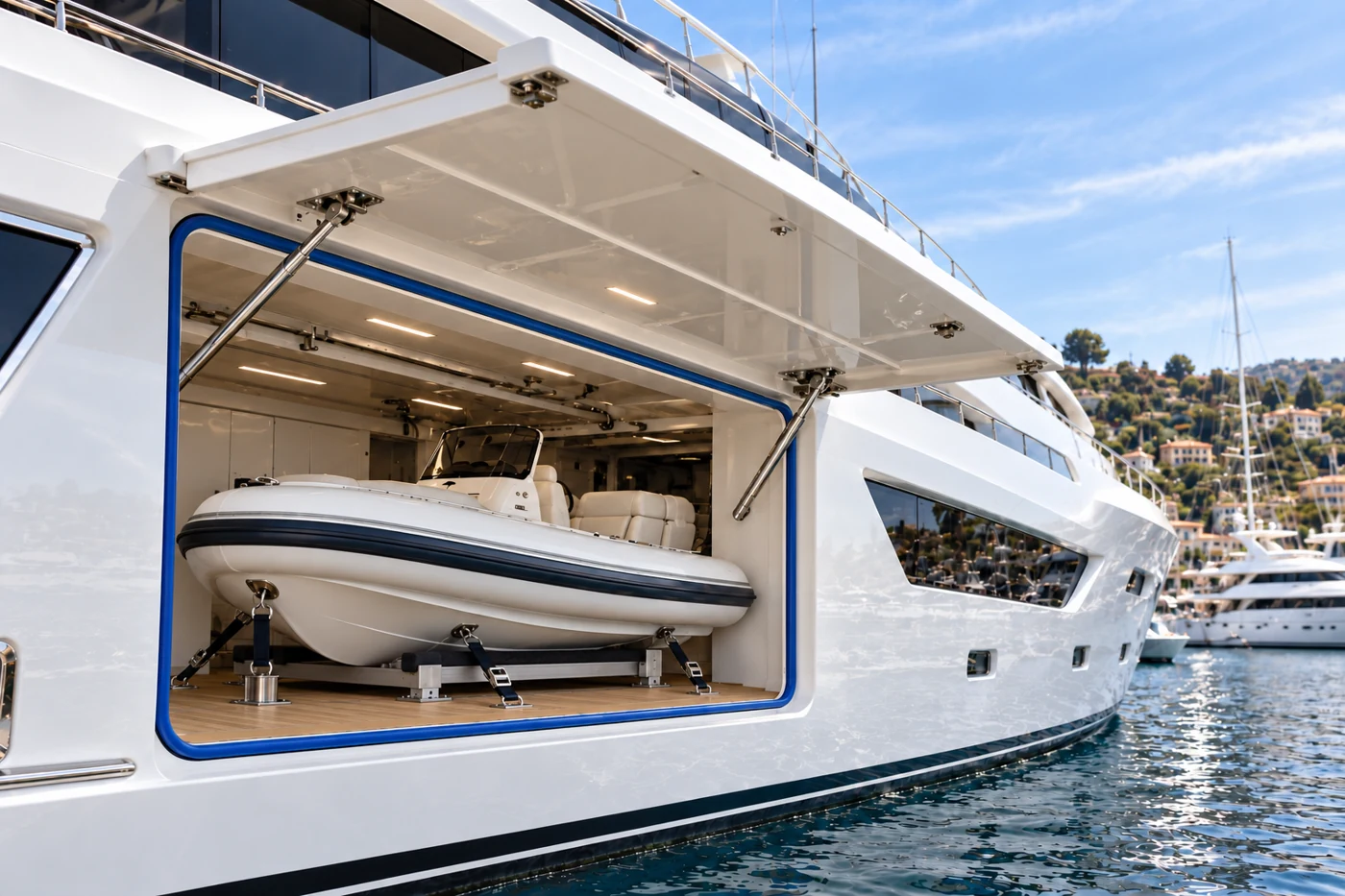
Side tender garage hatches
A sealing path suited to large tender and equipment garage openings.
Used on hull-side garage hatches for tenders, personal watercraft and watersports equipment. The large opening simplifies handling, while the closed hatch must seal a long perimeter joint.
The seal is retained in a channel or mechanical holder around the fixed garage opening. Inflation follows correct seating and locking of the top-hinged hatch. The tender cradle and tie-down equipment operate as a separate securing system.
Benefits of the seal
Compartment protection. Helps reduce water and dirt passage under the specified operating conditions.
Adaptable geometry. Long straight runs and corners can be formed into a closed loop suited to the selected profile.
Serviceability. Accessible channels, air inlets and connections simplify inspection, measurement and replacement.
Our manufacturing solution
We manufacture custom inflatable seals for this type of equipment. We assess the section, closed-loop dimensions, corner radii and air inlet arrangement against your drawing, and select the material for the temperature, product contact and cleaning conditions.
Selection and installation details
Match the hatch and recess dimensions and provide a continuous mating strip opposite the seal. Internal hydraulic-arm brackets, tender handling rails and tie-down straps must not interrupt the seal channel or transfer loads into the profile.
Hatch locking and tender restraint have separate roles; the seal provides perimeter contact.
Enlarge image ↗Seal location: Channel around the fixed opening and the mating surface of the closed leaf
05 / EQUIPMENT AND PURPOSE
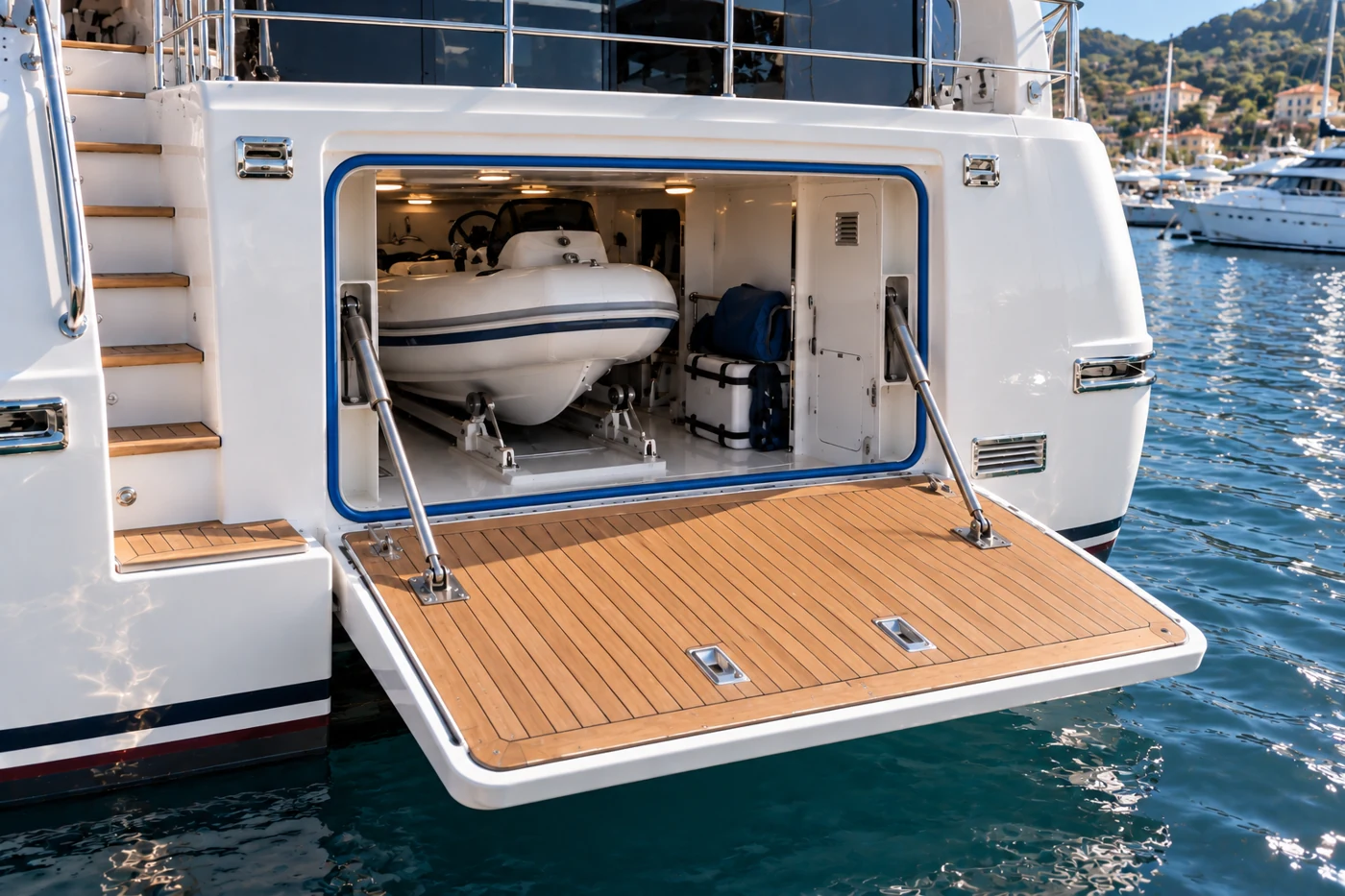
Transom garage / platform hatches
Sealing designed for the closed position of a fold-down platform.
Suitable for downward-opening transom garage hatches that serve as a platform when open. Depending on the yacht, this area may provide tender access, equipment loading or a working platform close to the water.
The perimeter seal is installed around the fixed garage opening. It inflates after the platform has been raised, seated and mechanically locked. Before lowering, the air is fully vented and the profile releases from the mating surface.
Benefits of the seal
Controlled contact at the sill. Supports continuity of the sealing path near the lower hinge region.
Closed-compartment protection. Works with the hatch assembly to help limit water and dirt entering the garage.
Defined perimeter installation. The retained loop follows a consistent path around the opening.
Our manufacturing solution
We manufacture custom inflatable seals for this type of equipment. We assess the section, closed-loop dimensions, corner radii and air inlet arrangement against your drawing, and select the material for the temperature, product contact and cleaning conditions.
Selection and installation details
When the platform is open, its loads are carried by the hinges, supports and hull structure, not the seal. Check the lower sill for sand, salt and accumulated dirt that could affect the mating surface, drainage or profile retraction.
Check the platform-to-recess fit, fully closed position and lower corner geometry together.
Images are representative application designs, not photographs of customer installations. The final profile, material and operating values are established during project review.
PREPARING YOUR PROJECT
What information is needed for selection?
Technical drawings and photographs of the existing installation help us assess the profile and connection options together. Include the following information with your enquiry.
Application-specific selection information
Information to provide
Assessment details
Door and hatch drawing
Closed perimeter, corner geometry, retainer section and mating surface profile.
Movement and clearance
Closed gap around the full perimeter, hinge or sliding arrangement and locking points.
Marine environment
Salt water, sunlight, cleaning products and other media contacting the seal.
Project acceptance
Leak testing, material documentation and any project-specific classification requirements.
Frequently asked questions
Can seals be made for curved or large hatches?
Perimeter dimensions, corner radii and the mounting groove are reviewed together. Manufacturing suitability is established from the drawing and operating gap.
Does the seal replace the hatch lock?
Hatch positioning and mechanical locking are provided by the equipment. The inflatable seal contributes to sealing by contacting the mating surface in the correct closed position.
How is water tightness verified?
Target conditions and acceptance criteria are defined at the start of the project. Final performance depends on testing the installed hatch and seal arrangement.
Catalogue & technical resources
Explore the related catalogue and review profile and installation options alongside your application drawing.

 Enlarge image ↗