Inflatable sleeves for the connection between a filling spout and the bag neck. Explore single and twin filling stations, conveyor lines and drum follower plate seals with illustrated application examples.
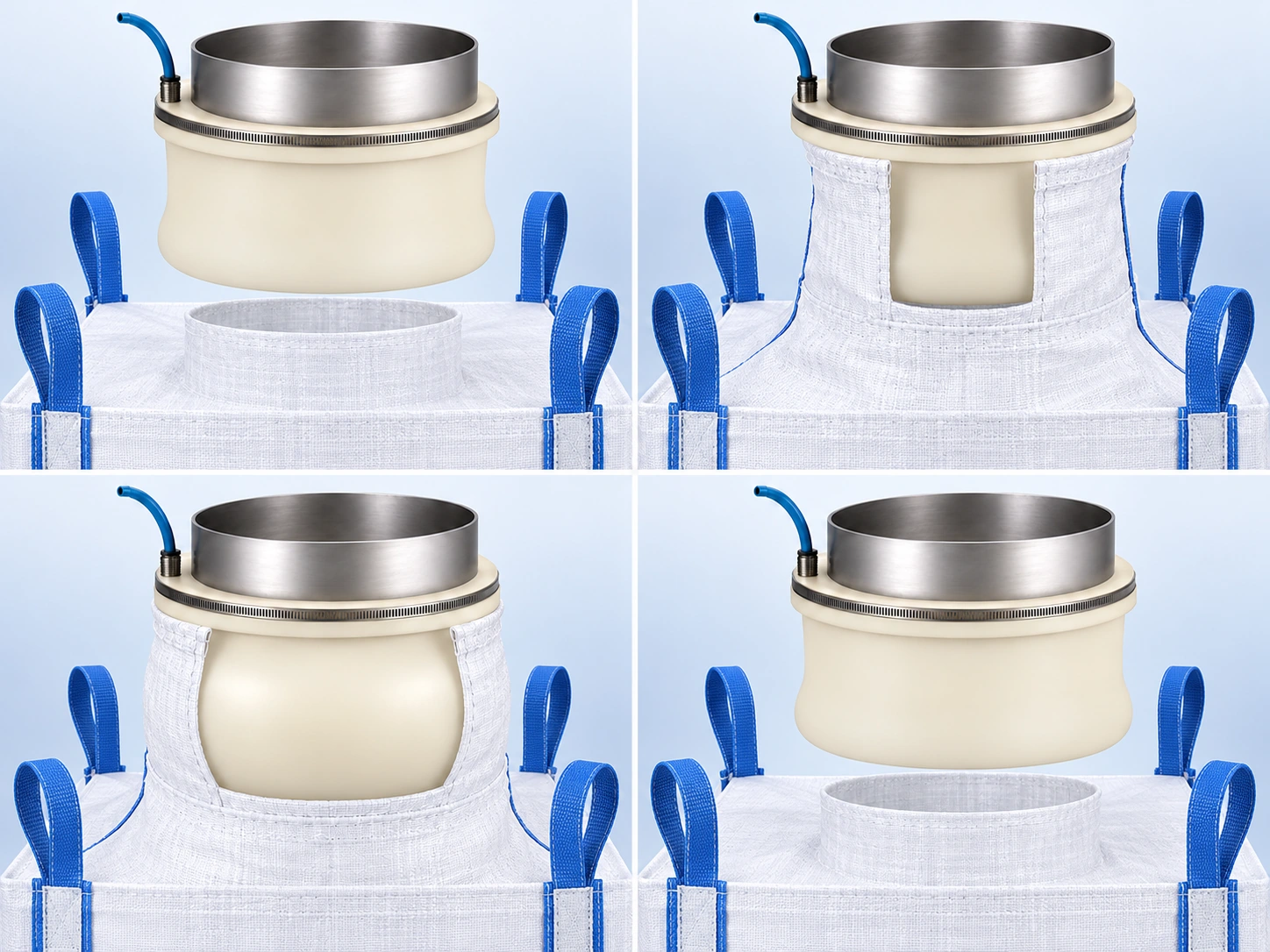
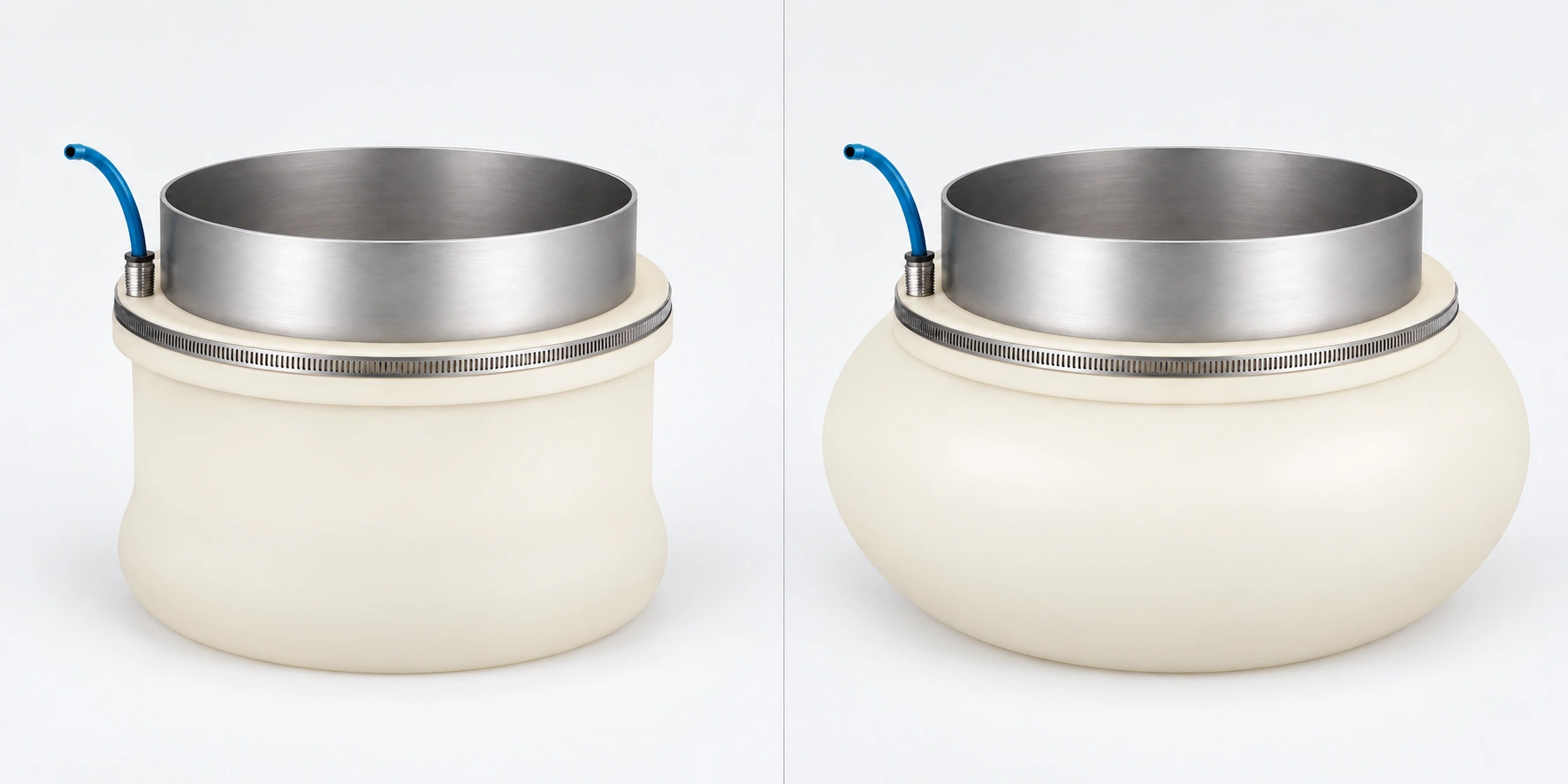
Left: deflated. Right: expanded with air. Mounting diameter, retaining band and air inlet stay the same; the flexible body expands outwards.
BIG BAG FILLING
Big bag filling sleeves: controlled contact at the inlet.
We manufacture custom inflatable filling sleeves for the spout-to-bag neck connection. Fitting when deflated, establishing contact with air and releasing after venting are stages of the same sleeve.
Big bag filling
Sack filling
Drum unloading
What we assess when selecting a seal
Spout outside diameter and bag inlet size
Mounting surface and air connection
Product, temperature and cleaning conditions
APPLICATION DETAILS
How the filling sleeve works, its benefits and applications
See the seal close up, explore how it contacts the bag inlet and compare dust escape at an open connection. Machine examples show where the seal is used.
Enlarge image ↗Seal location: Between the outside of the filling spout and the bag filling neck
01 / SEAL AND CONNECTION
Big bag filling sleeve
Controlled circumferential contact at the bag inlet, with an open central product passage.
The sleeve works between the outside of the filling spout and the inlet of an FIBC or a suitable necked sack. Inflation establishes circumferential contact; venting allows a bag change. Product passes through the open centre into the bag.
The sleeve mounting bore is matched to the spout outside diameter. The bag neck is placed over the deflated sleeve; air pressure expands the flexible body outwards against the bag inlet. Filling stops before the air is vented and the bag is released. Product passes through the open central tube; the sleeve does not support the bag weight.
Benefits of the seal
Helps reduce dust escape. Circumferential contact helps limit product escaping to the surroundings at the filling connection.
Easier bag changes. Venting relaxes the sleeve so the bag inlet can be fitted or removed.
Accommodates inlet variation. A correctly selected flexible body can accommodate limited variations in bag neck dimensions.
Our production for this application
We manufacture broad inflatable filling sleeves to suit your spout outside diameter, bag inlet and mounting arrangement. The air connection is positioned for accessible maintenance and protection from movement.
The bag inlet connection, step by step
Four-loop FIBC with a central filling neck. The fabric opening is an illustrative cutaway showing sleeve contact; it is not an opening in the real bag.
01 / Prepare the connection
With the sleeve deflated, centre the FIBC inlet below the head. Hooks and/or a platform support the bag weight.
02 / Fit the inlet
Place the neck over the sleeve without wrinkles. Keep the retaining band and air connection accessible above the inlet.
03 / Inflate and fill
Establish circumferential contact with air. Confirm the connection before filling; product passes through the open central path.
04 / Stop, vent and release
Stop product feed first. Vent the sleeve; remove the relaxed inlet and discharge the bag using its handling arrangement.
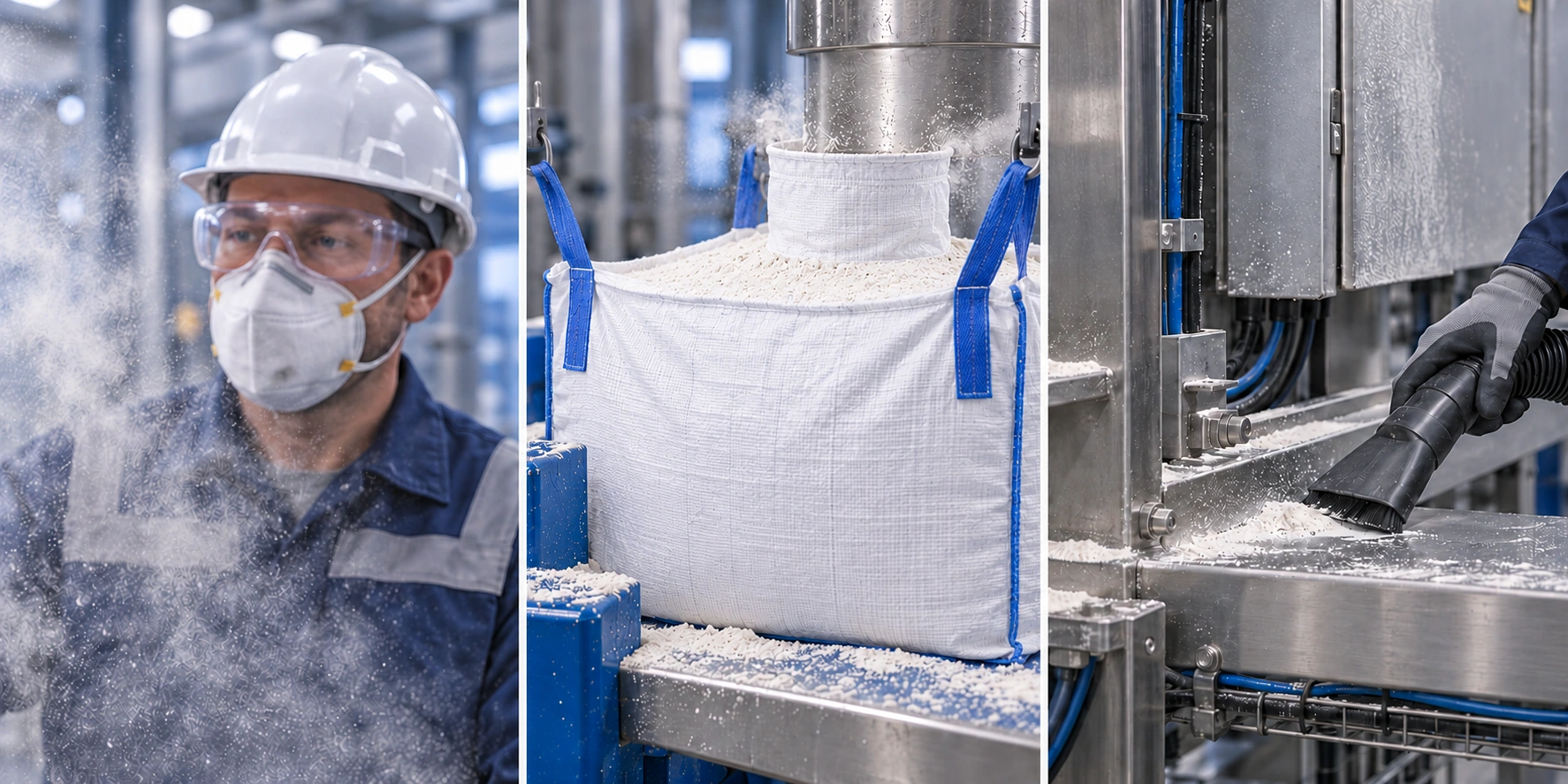
What can happen at an open inlet gap?
Escaping dust, product loss and contamination of the work area.
Left: dust escape at an open filling connection. Right: circumferential bag-inlet contact with an inflatable sleeve. This is illustrative, not a measured performance result.
Open connection
The gap between the spout and bag neck can provide a path for powder to escape into the surrounding work area.
Sleeve contact
A correctly sized sleeve expands outwards against the inlet, helping reduce dust escape at this connection.
Dust near the breathing zone, escaped product and removal of powder deposited on equipment surfaces.
Worker exposure
Depending on dust type, amount and duration of exposure, respiratory problems or eye and skin irritation may occur. Assess the actual product and workplace exposure.
Product escaping before it enters the bag can settle on the shoulder, platform or floor. Whether it can be recovered depends on the process conditions.
Cleaning and contamination
Deposits require cleaning of equipment and packaging surfaces. Transfer to nearby products is considered in hygiene and cross-contamination assessment.
The filling sleeve is one sealing component at the connection. Assess it together with dust extraction, ventilation, cleaning and appropriate personal protective equipment.
Selection and installation details
Fit the bag → inflate the sleeve → start filling → stop filling → vent the sleeve → release the bag.
Sleeve pressure and cycle times depend on the application; bag-body inflation and dust extraction are separate systems.
Bag weight is carried by the lifting hooks and/or the support platform.
Confirm the connection and bag position before filling; do not release the bag before filling has stopped.
Enlarge image ↗Seal location: At the bag filling neck around the central filling spout
02 / SEAL AND CONNECTION
Filling sleeve at a single head
Sealing at the big bag inlet, independently of the bag support structure.
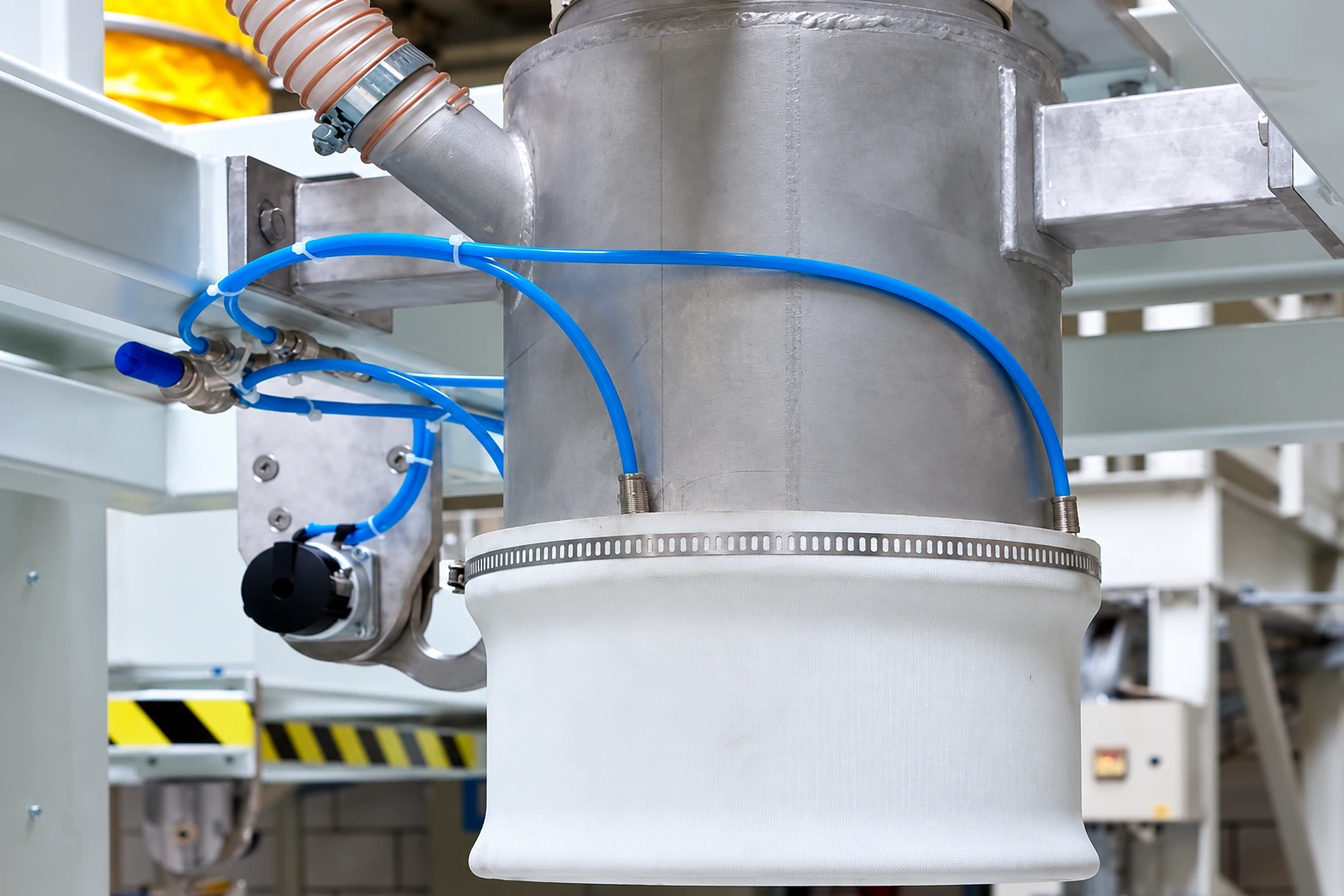
The sleeve at a single filling head is selected for the spout outside diameter and bag inlet. Contact length, retaining band and air inlet position are matched to the existing head. Hooks and/or a support platform carry the bag load.
The sleeve sits on the outside of the filling spout. The bag neck is fitted over it and the flexible body is inflated to contact the inlet circumference. The lifting arrangement and platform carry the bag; the filling sleeve is not a load-bearing suspension.
Benefits of the seal
Dust control at the connection. Reducing the inlet gap supports more controlled filling.
Orderly bag changes. The deflated state allows the filling neck to be released from the spout.
Adaptation to existing equipment. Suitable mounting geometry can support a new filling head or a replacement seal.
Our production for this application
We manufacture sleeves matched to your unit’s spout, bag neck and retaining arrangement. We assess the pneumatic line, lifting mechanism and operator access together.
Selection and installation details
The filling spout and bag inlet must be concentric.
Lifting-loop positions should not pull the filling neck sideways.
Weighing, filling cut-off and any dust extraction are assessed within the machine control arrangement.
Bag neck height and sleeve contact length are measured together.
Enlarge image ↗Seal location: At the spout-to-bag inlet connection on the filling head
03 / SEAL AND CONNECTION
Filling sleeves in conveyor lines
Repeatable connections in lines with sequential filling and bag discharge.
In a conveyor line, the sleeve works at the filling-head inlet. It establishes contact and releases during repeated filling and bag changes. Venting time and access for replacement are assessed against the line sequence.
The bag is secured at the filling position and its neck is placed over the deflated sleeve. Once inflation, filling and venting are complete, the bag is released to the handling system. The sleeve works at the filling head; the connection is released before conveyor movement.
Benefits of the seal
Organised cycles. Inflation and venting can be included in the bag-change sequence.
Repeatable connection. Correct centring and mounting help establish similar contact from bag to bag.
Maintenance access. Suitable air inlet and clamp positions make sleeve replacement easier.
Our production for this application
We assess the sleeve length, mounting diameter and pneumatic connection for the line’s filling head using your drawing. Hose routing is planned to avoid trapping during bag entry and discharge.
Selection and installation details
Do not start conveyor movement before releasing the bag connection.
Allow for sleeve inflation and venting times in the machine cycle.
Clamp and spout surfaces must not have sharp edges that damage the flexible body.
Provide access for cleaning and sleeve replacement.
Enlarge image ↗Seal location: Around each station’s own filling spout and bag neck
04 / SEAL AND CONNECTION
Independent sleeves at two heads
Independent inflatable sleeve connections at two separate filling heads.
Each of the two filling heads uses its own sleeve. Matching heads may share a seal geometry; different dimensions require separate parts. Inflation and venting are assessed independently at each connection.
Each sleeve works at its own bag inlet. Inflation and venting are controlled separately according to bag position and filling status. Changing a bag at one head must not release the connection at the other head.
Benefits of the seal
Independent connections. Each bag neck has its own contact and release sequence.
Flexible operating sequence. Bag preparation and filling can alternate where the machine design permits.
Standard maintenance parts. Matching heads can share a sleeve geometry to simplify spare-part management.
Our production for this application
We assess the spout and bag dimensions at each head, preparing shared sleeve geometry for matching heads or separate geometry where needed. Air inlet directions are planned around each station’s movement envelope.
Selection and installation details
Confirm bag position and filling connection separately at each station.
Arrange air lines and control valves so the stations do not interfere with each other.
Product routing and filling cut-off in a shared supply depend on the machine design.
Check installation and maintenance space for both heads.
Enlarge image ↗Seal location: Around the perimeter of the follower plate travelling inside the drum
05 / SEAL AND CONNECTION
Drum follower-plate seal
A follower-plate seal providing controlled contact with the drum’s inner wall.
For viscous products, this seal works between the follower-plate perimeter and the drum bore. Its mounting geometry differs from a filling sleeve: perimeter contact is maintained as the plate follows the product level.
The circumferential inflatable seal works between the follower-plate edge and the drum wall. Inflation expands it outwards against the wall, helping maintain perimeter contact as the plate follows the product level. The seal is vented in accordance with the machine’s plate-lifting sequence before removal.
Benefits of the seal
Circumferential contact. Helps limit the gap between the plate edge and the drum.
Reduced product loss. A suitable plate and seal arrangement can help reduce product remaining on the wall.
Drum changeover. Controlled venting helps release the plate and prepare for a new drum.
Our production for this application
We manufacture closed-loop inflatable seals to suit your drum bore, follower plate and groove. We assess product compatibility, wall friction, cleaning conditions and protection of the air inlet throughout the plate’s travel.
Left: follower plate before entry. Right: the perimeter seal contacts the drum bore. The opening in the drum wall is an illustrative cutaway.
Selection and installation details
Check drum bore, ovality and the condition of the internal wall.
The follower plate must travel centrally; the seal is not a mechanical centring device.
Plan pumping, plate movement, venting and any pressure equalisation within the machine’s own operating sequence.
Seal pressure, plate travel and elastomer friction are determined for the application.
Images illustrate the product and its applications; cutaways reveal the contact interface. Final dimensions, material and operating conditions are determined for your application.
PREPARING YOUR PROJECT
What information is needed for selection?
Technical drawings and photographs of the existing installation help us assess the profile and connection options together. Include the following information with your enquiry.
Application-specific selection information
Information to provide
Assessment details
Spout and bag neck
Filling spout diameter, bag inlet dimensions, fabric and any inner liner.
Sleeve installation
Deflated clearance, active contact length, retainer arrangement and air connection.
Product and cycle
Filled product, dust behaviour, cleaning method and filling frequency.
Drum application
Follower plate diameter, drum internal tolerances, material contact and emptying arrangement are assessed separately.
Frequently asked questions
Does the filling sleeve support the bag's weight?
The machine's lifting and support arrangement carries the bag load. The sleeve establishes contact around the bag neck within a suitable connection geometry.
Can one sleeve fit different bag necks?
The permitted size range depends on the profile, spout diameter, bag construction and operating clearance. Unlimited expansion across different sizes should not be assumed.
Does the seal replace dust extraction?
The seal helps limit an open gap at the connection. Dust extraction, ventilation and other process controls are considered together according to the equipment and product conditions.
Catalogue & technical resources
Explore the related catalogue and review profile and installation options alongside your application drawing.

 Enlarge image ↗